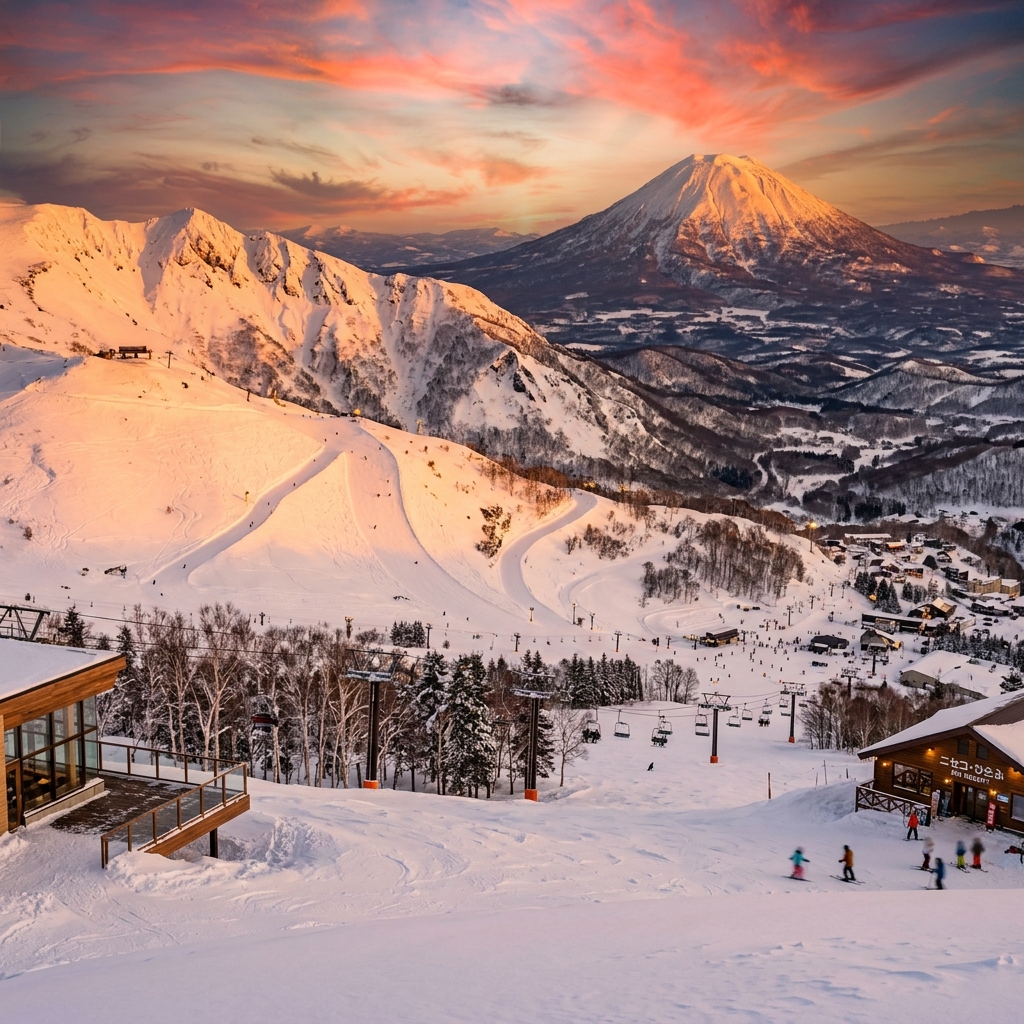
Carve down from the summit at first light and on every side of you stand thousands of fir trees caked thick with ice and snow, glowing soft and gold in the morning sun like something out of a Studio Ghibli frame. Cold air bites your cheeks, your edges hiss through dry snow, and an hour later you are sinking neck-deep into milky sulphur water that has steamed up from the ground here since the 1900s. These are the juhyo, the "snow monsters," and on weekend nights they light up red and blue. No other Japanese ski hill gives you this one image. That one image is why Xiaohongshu and Korean Naver blogs fill with Zao photos every January, and once you stand among them you will understand exactly why.
Zao is less about chasing deep powder and more about something you cannot get anywhere else. Compared with Niseko, where you will hear more Australian and Hong Kong accents than Japanese, Zao still feels like a real Japanese onsen town with a ski hill attached, and it costs noticeably less. Here is the honest part, friend to friend: the snow is drier and less famous than Hokkaido, the village is older and quieter, and you are a shinkansen-plus-bus ride deep into Tohoku rather than a quick transfer from a major airport. None of that takes away from the magic. It just means you come for the scenery and the soak, and you will leave glad you did.
📊 Honest scorecard, friend to friend (1 to 10)
Onsen scene10/10One of Japan's best onsen towns, strong sulphur water since the 1900s
Beginner-friendly8/10Wide Uwanodai and Paradise slopes, gentle and forgiving
Value for money8/10Cheaper lift, lodging, and food than Hokkaido headline resorts
Family with young kids7/10Gentle slopes plus ski school, and the multi-zone layout is simple once you learn one route on day one
Powder Snow quality6/10Good volume, just drier and wind-affected up top rather than Hokkaido fluff, still a fun ride
Food variety (Asian palate)6/10Genghis Khan lamb, soba, konnyaku, with fewer late-night options so plan dinner a touch earlier
Crowds (lower is better)6/10Lovely and quiet on the slopes, with juhyo ropeway lines that fill up mid-winter mornings, so go early and skip them
English signage5/10Some English on maps and lifts, with a few gaps deeper in the village, easy to navigate with a little planning
Korean support5/10Korean website, Korean visitors common, some Korean menus
Vegetarian options4/10Soba and konnyaku are your friends, and since meat and dashi are common, ask kitchens and they will help
Access from airport4/10No close major airport, so it is a shinkansen plus bus from Tokyo, an easy route once you have the plan
Apres / nightlife4/10A peaceful onsen town of baths and izakaya rather than a party scene, perfect if you want to unwind
Mandarin support3/10Some Chinese menus and staff already, no dedicated Mandarin ski school yet, so book lessons in advance and you are set
Thai support2/10Thai signage is still thin here, so a translation app on your phone will be your friend, easy to manage
Halal availability2/10No dedicated halal restaurant yet, though hotels accommodate with notice, so give them a heads-up before you arrive
🎿 The terrain, honestly
Zao is one of the largest ski areas in Tohoku, about 127 hectares spread across interconnected zones with around 40 lifts and ropeways, a summit near 1,661 m and a vertical drop close to 880 m. The split is roughly 40% beginner, 40% intermediate, 20% advanced, so it skews nicely toward easy and relaxed cruising.
Beginners live on the Uwanodai slope, the oldest run at Zao, right by the village and used for lessons and kids, plus the wide Paradise slope up top. Intermediates get the most fun of all: the Juhyogen (snow monster) course runs roughly 10 km from Jizo summit down through the rime-ice trees, a genuinely once-in-a-trip cruise on a clear morning. Advanced skiers are not left out, with the Hanenkamm course, an FIS-sanctioned black with A, B and C pitches, plus steeper lines off Yokokura.
A couple of friendly heads-ups. Off-piste and tree skiing are officially restricted, and the summit is exposed, so when wind and cloud roll in (common in juhyo season) the upper ropeways pause and visibility drops to near zero. The mountain is also spread out and a little maze-like, so a first-timer can waste time figuring out which ropeway connects to what. The fix is simple: grab the map, ride the Zao Ropeway up in two stages (Sanroku to Juhyo Kogen to Jizo Sancho), and learn that route first. Do that and the whole mountain opens up to you.
🍽️ 5 things to eat (real names + prices)
Genghis Khan
grilled lamb. Zao claims to be one of the dishes' early homes. A bowl runs about Y1,000 to Y1,400, a set with rice and miso about Y1,500 to Y1,800. Try Oshokujidokoro Tomitaya or Robata in the village.
Tama konnyaku, round skewered
konnyaku balls simmered in soy dashi, sold steaming at ropeway stations and shop fronts for around Y100 to Y300 a skewer. The cheapest, most Zao snack there is, and weirdly addictive.
Yamagata soba. The prefecture
is a top buckwheat region. A seiro of cold soba is roughly Y900 to Y1,300 at village soba shops.
Imoni, a local taro-and-beef
soy stew, pure comfort after a cold day, around Y500 to Y800 a bowl where available.
Ropeway summit meal at
restaurant Sancho near Jizo Sancho station: a hot curry or ramen with a snow-monster window view, roughly Y1,000 to Y1,400. You pay a little for the view, and on a clear day it is absolutely worth it.
🏨 Where to stay: picks across price ranges
💎Luxury · Zao Kokusai Hotel. Good private: (kashikiri) baths, and it will accommodate vegetarian or no-beef religious diets with about 5 days notice, which is a real help for Muslim and vegetarian Asian guests. One thing to know: its main shared bath does not allow tattoos.
⭐Mid-range · Takamiya or att.Ryokan-style onsen ryokan in the village: , kaiseki dinner plus private onsen, a comfortable and romantic base for couples.
💰Budget · Lodge Scole and similar family-run pensions and minshuku: , simple rooms, ski-in proximity, and friendly owners who help with lift tickets.
🔰Best base for first-timers · anything within walking distance of the Uwanodai slope and the bus terminal: , so you can ski, eat, and bathe without transport once you arrive. Less hassle, more soaking.
🚄 Getting there from Asian cities (no rental car)
The clean route for almost everyone is via Tokyo, since there is no large international airport close to Zao. Do not let that put you off, the journey is straightforward once you have it mapped.
From Tokyo: take the Yamagata Shinkansen from Tokyo or Ueno to Yamagata Station, about 2.5 to 3 hours, around Y11,000 to Y11,500 reserved. At Yamagata Station bus terminal, the Zao Onsen bus takes about 40 minutes for roughly Y1,200. Total: about 3.5 to 4 hours door to door.
Overnight option: a seasonal direct night bus runs from Busta Shinjuku (Tokyo) to Zao Onsen, around 7 hours, roughly Y4,500 to Y8,000 depending on date. It is cheaper and saves a hotel night, just know you arrive a little tired.
Via Sendai: if you land at or pass through Sendai, take the highway bus or train to Yamagata, then the Zao bus. Sendai works well for travelers combining a Tohoku trip.
Buy a JR East Pass (Tohoku area) if you are doing multiple Tohoku legs, since it can cover the Yamagata Shinkansen and save money over single tickets.
🇹🇭 Bangkok · no direct path: , so fly to Tokyo (Narita or Haneda), then shinkansen plus bus as above. Budget a half day of transfers and enjoy the ride.
🇸🇬 Singapore and Kuala Lumpur · fly to Tokyo: , same shinkansen-plus-bus route.
🇭🇰 Hong Kong and Taipei · fly to Tokyo: , then the Tokyo route. Sendai flights are rarer, so Tokyo is simplest.
🇰🇷 Seoul · Korean visitors sometimes route via Sendai when flights suit: , otherwise via Tokyo. Yamagata Airport exists but has very limited international service, so treat it as domestic-only in practice.
💡 ทิปจากคนใน
- Ride the juhyo ropeway early, before 9:30 am. Mid-morning lines in peak season (late January to mid-February) get long, and afternoon cloud often hides the summit, so the early start gives you the clear, quiet view everyone hopes for.
- The big Zao Dai-Rotenburo open-air river bath is closed in winter (late November to mid-April), so do not plan your trip around it. Use the village baths and your hotel onsen instead, they are wonderful.
- Use the three old public bathhouses: Kawarayu, Shimoyu, Kamiyu, around Y200 each, often honor-system payment. Bring small coins and your own small towel and you are good to go.
- Snow monsters need cold and snow to fully form, so they are best mid-January to late February. Come in December and they may still be small, lovely but petite.
- The night illumination runs Friday to Sunday roughly late December to late February (2025-26 dates published by the ropeway). Check the official schedule, because exact lit nights change yearly and you will not want to miss it.
- Buy lift tickets at the counter with an IC card, no advance booking needed. Keep the IC deposit receipt for your refund.
- Layer for wind, not just cold. The summit is exposed and the ropeway can stop in storms, so have a happy backup plan for a white-out day (village onsen, soba, souvenir streets). Some of the best Zao memories happen on those slow days.
- The village is on a slope, so note where your hotel sits relative to the bus terminal and lifts before you book. A little planning here saves you from hauling luggage uphill in snow.
⚠️ ข้อควรระวัง
- Assuming the famous big outdoor river bath is open in ski season. It is not, and people show up disappointed every winter, so plan around your hotel onsen and the village baths instead.
- Carrying too little cash. Smaller village shops, the Y200 honor-system baths, and some eateries are cash-first, so withdraw yen at a 7-Eleven or post office ATM in Yamagata City or Tokyo before you head up, because village ATM access is limited. Sort this early and you will never think about it again.
- Tattoo confusion. Some hotel baths (for example Zao Kokusai Hotel's main bath) refuse tattoos, while several village and outdoor facilities are relaxed. If you have ink, book a room with a private (kashikiri) bath and you can soak in total peace.
- Buying the wrong pass. Day-trippers chasing only the snow monsters may want the ropeway sightseeing ticket, not the full lift pass. Skiers want the all-mountain lift pass. They are different products, so pick the one that matches your day.
- Underestimating transfer time. It is shinkansen plus a 40-minute bus, not a single airport transfer, so build in a little buffer, especially with kids. A relaxed arrival beats a rushed one.
- Onsen etiquette slips. Wash fully at the seated showers before entering, no swimwear, tie up long hair, and no large towel in the water. The sulphur water is also slightly acidic, so rinse silver jewelry off, then settle in and enjoy.
★ ก่อนไปต้องรู้
- Access is a bit of a journey. Shinkansen plus a 40-minute bus, with no major international airport nearby, makes Zao more of a commitment than Niseko or resorts close to Tokyo. Map it once, build in a buffer, and the trip itself becomes part of the fun.
- The snow and terrain suit cruisers more than hardcore skiers. It is scenic and beginner-friendly rather than steep-and-deep, and off-piste is restricted. Summit weather can also shut the upper ropeways exactly when you want the monster views, so plan a couple of clear-morning windows and keep a cozy white-out plan ready. You will still get your shots.
- Asian-specific support is still growing. No dedicated halal restaurant yet, limited vegetarian-friendly menus, no known Thai or dedicated Mandarin ski instruction, and patchy village ATM access. The fix is easy: carry enough cash, flag dietary needs to your hotel before you arrive, and keep a translation app handy. Sort those three and you are all set for a smooth, happy trip.
📷 Photo Spot
📸 Jizo Sancho summit station
the dense snow monster field right by the ropeway exit. Best in clear morning light, 9 to 11 am.
📸 The Juhyogen course mid-slope
skiing or standing among the rime trees with the valley behind. Late morning on a bluebird day.
📸 Night juhyo illumination
near the upper ropeway on a lit weekend evening, the signature red and blue glow that fills Xiaohongshu and Naver. Dress very warm, it is brutally cold, and so worth it.
📸 Zao Jizoson, the stone
Jizo statue near the summit, half-buried in snow. Atmospheric in soft light.
📸 The old onsen village lanes
at dusk, steam rising from the gutters and warm lantern light, a quieter, human counterpoint to the summit shots.
📅 สภาพหิมะในแต่ละเดือน
Late November to early December · season opens
, snow building, monsters not yet formed. Cheapest and quietest, though cover is thin. Skip if juhyo is your goal.
December · snow deepening
, monsters start to take shape late in the month. Illumination begins around late December. Good value and fewer crowds.
January · cold sets in
, monsters grow fast, scenery gets dramatic. Peak juhyo viewing starts mid-month. Mornings on the ropeway get busier, especially weekends and Lunar New Year travel, so start early.
February · the headline month. Monsters at full size
, some reaching several meters, illumination in full swing. Best scenery, coldest weather, biggest crowds and highest demand for lodging, so book early and you are golden.
March · monsters begin to fade as it warms
, snow still skiable, crowds thin, prices ease. A relaxed time to ski if photos are secondary.
April to early May · spring snow on lower runs
, long season tail, and the big outdoor river bath reopens around mid-April. No monsters, mellow conditions, lovely for a quiet late-season trip.
⚖️ Compare to alternatives
🎿Choose Zao Onsen if you want the snow monsters, a genuine old onsen town, and lower costs, and you are happy with mostly green and red cruising.
🎿Choose Niseko if you want the deepest, most reliable powder, the most English and international services, and a lively dining and nightlife scene, and you do not mind paying significantly more.
🎿Choose Hakuba if you want big-mountain advanced terrain and a wide variety of linked resorts within reach of Tokyo, with stronger apres than Zao but without the monster forest.
🎿Choose Appi Kogen or Geto Kogen (also Tohoku) if you want quieter, well-groomed runs and value similar to Zao but care less about onsen-town atmosphere and the juhyo spectacle.